
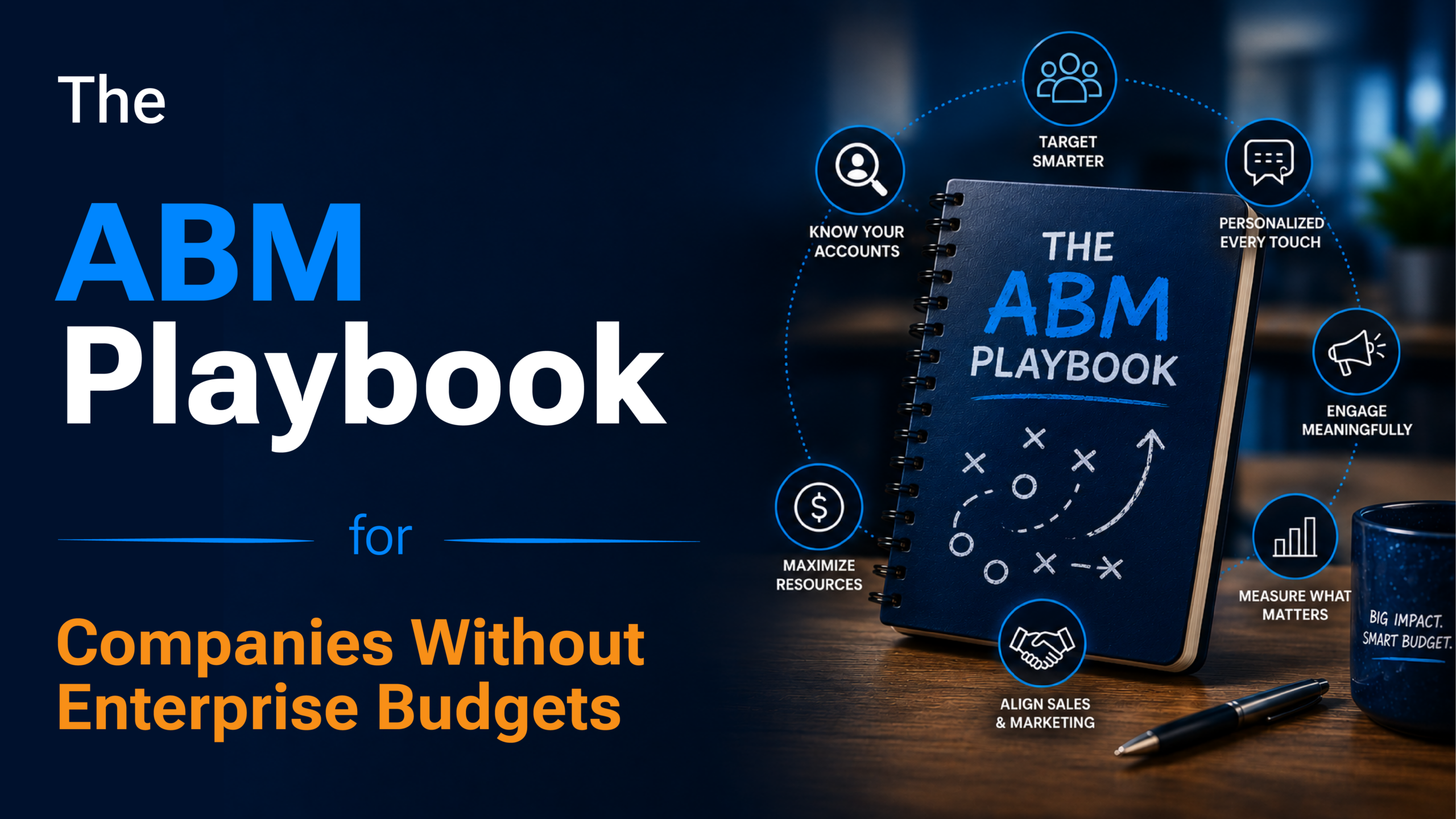
The ABM Playbook for Companies Without Enterprise Budgets
The most common complaint about ABM campaigns comes from both ends of the spectrum. Large enterprise accounts invest tens or hundreds of thousands of dollars a year in ABM platforms and many still don’t see the ROI they were expecting. SMBs, meanwhile, shy away from ABM campaigns because they don’t have the budget to invest in the tools they think they need to launch an ABM campaign.
Both groups are working from the same flawed assumption that ABM success is based on the tools you use and how much you invest in them. It isn’t!
Most companies and most ABM platforms, confuse spending with execution. They assume that more data, more automation, and more visibility generates better results. But ABM isn’t about volume or sophistication. It’s about focus and alignment. And here’s the insight that changes everything for SMBs, a smaller budget forces you to get those fundamentals right.
You don’t need a six-figure ABM stack to outperform enterprises that built one.
ABM Isn’t a Platform – It’s a Discipline.
ABM stands for Account-Based Marketing. At its core, it means identifying a specific set of high-value accounts, building a coordinated campaign tailored to each one, and measuring success by pipeline value per account, not lead volume.
That’s fundamentally different from traditional demand generation, which casts a wide net and counts on conversion rates to balance the spend. ABM is targeted. ABM is expensive per account to execute well. But ABM converts at higher rates because you’re speaking directly to the accounts and personas most likely to buy.
Here’s what’s critical, ABM only works when sales and marketing are aligned on the account list and the execution strategy. If marketing is running an ABM campaign and sales isn’t coordinated, you’re just doing expensive outreach. That misalignment is often why that investment doesn’t pay off.
For SMBs, this is actually an advantage. You don’t have organizational silos. Sales and marketing can sit down, agree on 8 to 10 target accounts, and execute together. That alignment is what separates ABM from lead gen, and it’s free.
Identify Your Target Accounts – Start With What You Know.
Most companies already have their best customers. Start there. Look at your installed base and ask yourself:
- Which accounts are most profitable?
- Which ones do you genuinely help?
- What industry or vertical do they operate in?
That’s your north star for building your ideal customer profile. That’s your target account list. Not hundreds of companies. Pick 6, 8, maybe 12 accounts you genuinely believe you can help.
Build Account Intelligence and Develop Your Personas
Once you’ve got your list, don’t pitch yet. Learn first.
Start with LinkedIn. Look at the company page, recent posts, and identify the relevant decision-makers and influencers. Company websites and press releases will tell you about growth, new facilities, or recent investments. Trade publications and industry news often flag who’s modernizing or expanding.
This is where you develop your personas: The composite profiles of the actual people you’re trying to reach. A plant operations director at a mid-sized warehouse has different concerns than the CFO. Both might be involved in the buying decision, but they care about different things. Operations cares about uptime and accuracy. Finance cares about ROI and total cost of ownership.
AI tools like Claude can accelerate this. Feed it what you find. Company size, recent news, public job postings, their stated business challenges, and ask it to help you build those personas. What keeps a supply chain manager at a 500 person warehouse up at night? What metrics matter to them? What’s the buying process likely to look like?
You’re not buying intent-data feeds or predictive analytics. You’re using free tools and strategic thinking to build the same customer intelligence that enterprises pay hundreds of thousands for.
Craft Multi-Threaded, Personalized Outreach
Here’s where most outreach fails. Companies talk to one person and hope that person sells internally. In ABM, you’re talking to multiple stakeholders – your personas, because real buying decisions involve more than one voice.
Generic outreach gets ignored. Real ABM feels personalized because it is personalized to the account and to the specific role.
Your outreach to the operations director might focus on inventory accuracy and uptime. Your message to the IT leader might emphasize integration and support. Your message to finance might lead with TCO and ROI. Same account, different angles tailored to who you’re talking to.
For example – reference something specific to each persona and their priorities. If you’re the AIDC partner and you’re reaching out to operations:
“Noticed you’re ramping up your second shift, most warehouses that size run into inventory accuracy issues once volume picks up. That’s where we come in, both on the hardware side and with the configuration and support that makes it stick.”
You don’t need a marketing automation platform to execute this well. A handful of well-researched, personalized emails to multiple contacts at 12-15 target accounts will outperform a generic blast to 500 every time. And critically, sales is involved in these conversations from day one, not handing off a lead at the end.
Sales and Marketing Alignment: The Real Engine
This is the part that separates ABM from everything else. Sales and marketing work the same accounts together, not in sequence.
Marketing’s job is to build awareness and credibility with the account through personalized outreach, relevant content, and strategic touchpoints. Sales’ job is to move those conversations into discovery and opportunities. But they’re coordinating on timing, messaging, and next steps the whole way.
When a prospect engages with your outreach, sales knows about it. When sales learns something new about an account in a call, marketing adjusts the next message. That coordination is what creates the compounding effect that makes ABM work.
For SMBs without separate teams, this happens naturally. You’re all working from the same spreadsheet, talking to the same 12-15 accounts, and adjusting in real time. That’s an advantage over enterprises with better tools but slower internal processes.
Execute Without a Big Budget
Email and LinkedIn outreach cost you time, not money. A simple CRM, even a well-organized spreadsheet, keeps you and sales aligned on account progress and next steps. If you want to add a layer of automation, a low-cost outreach tool can help you sequence follow-ups without manual work.
The execution itself is straightforward: research, personalize, outreach, engage, hand to sales, stay coordinated. Repeat and refine.
Measure What Actually Matters
Forget vanity metrics. Track pipeline value per account, not lead volume. With a focused list of 12-15 accounts, measure three things:
How many accounts are you actively engaged with?
How many of those have turned into qualified conversations?
How many are in your sales pipeline, and at what stage?
You’ll know quickly what’s working, and you can adjust your messaging, persona targeting, or account list in real time. That agility is something enterprises with quarterly planning cycles can’t match.
Affordable Tools That Can Help
You don’t need an enterprise platform to run a disciplined ABM campaign. Here are a few budget-friendly options (not an endorsement, only examples).
- LinkedIn Sales Navigator: For identifying decision-makers and tracking account engagement
- io: Contact enrichment and outreach sequencing in one platform
- ai: Simple, low-cost email sequencing and cadence management
- Folk: Lightweight CRM built for small sales teams
- Clay: Enriching account data and pulling intelligence together
- Mailchimp: Managing coordinated email cadences across your target accounts
You don’t need all of them, pick one or two that fit your workflow.
The Real Advantage of a Smaller Budget
Here’s what enterprise budgets often miss. ABM isn’t won by spending more. It’s won by executing better.
A tight budget forces discipline. You can’t carpet-bomb accounts with generic content and hope something sticks. You must pick the right 12-15 accounts, understand them deeply, align your sales and marketing, and execute with precision. That’s harder than scaling a demand-gen program, but it converts better and builds real pipeline.
You don’t need a six-figure budget to run ABM well. You need focus, alignment, and strategy. SMBs with those three things will outperform enterprises throwing money at tools.
Ready to Build Your ABM Strategy?
ABM doesn’t require a massive budget or a complex stack. It requires clarity on who you’re targeting, alignment between sales and marketing, and disciplined execution. If you’re ready to build a focused account strategy that converts, let’s talk.
Reach out to discuss your target accounts, refine your personas, and map out a campaign that works for your budget and your team. No templates. No gatekeeping. Just a straightforward conversation about what ABM can do for your business.
Get in touch. Let’s build something that works.
480.349.9263